AMICA · Interview
È nata una stella
A Star Is Born
Interview feature · Milan, 2012
AMICA, Italy · pages 86–89
Photography: Giovanni Gastel · Millinery: Rachel Skepper
Sexy come Johnny Depp, elegante come un esotico Oscar Wilde, eclettico come Brian Eno.Sexy like Johnny Depp, elegant like an exotic Oscar Wilde, eclectic like Brian Eno.AMICA
Quando Benjamin Skepper suona il suo violoncello racconta il mondo, dai tempi di Bach (il Sid Vicious del barocco, dice) all’hip-hop con cui è cresciuto.When Benjamin Skepper plays his cello he tells the story of the world, from the age of Bach (the Sid Vicious of the Baroque, he says) to the hip-hop he grew up with.AMICA
THE FEATURE
Text: Stefania Romani
Photography: Giovanni Gastel
A four-page interview, published in the same issue as the fashion story La musa e l’artista.
THE PORTRAIT
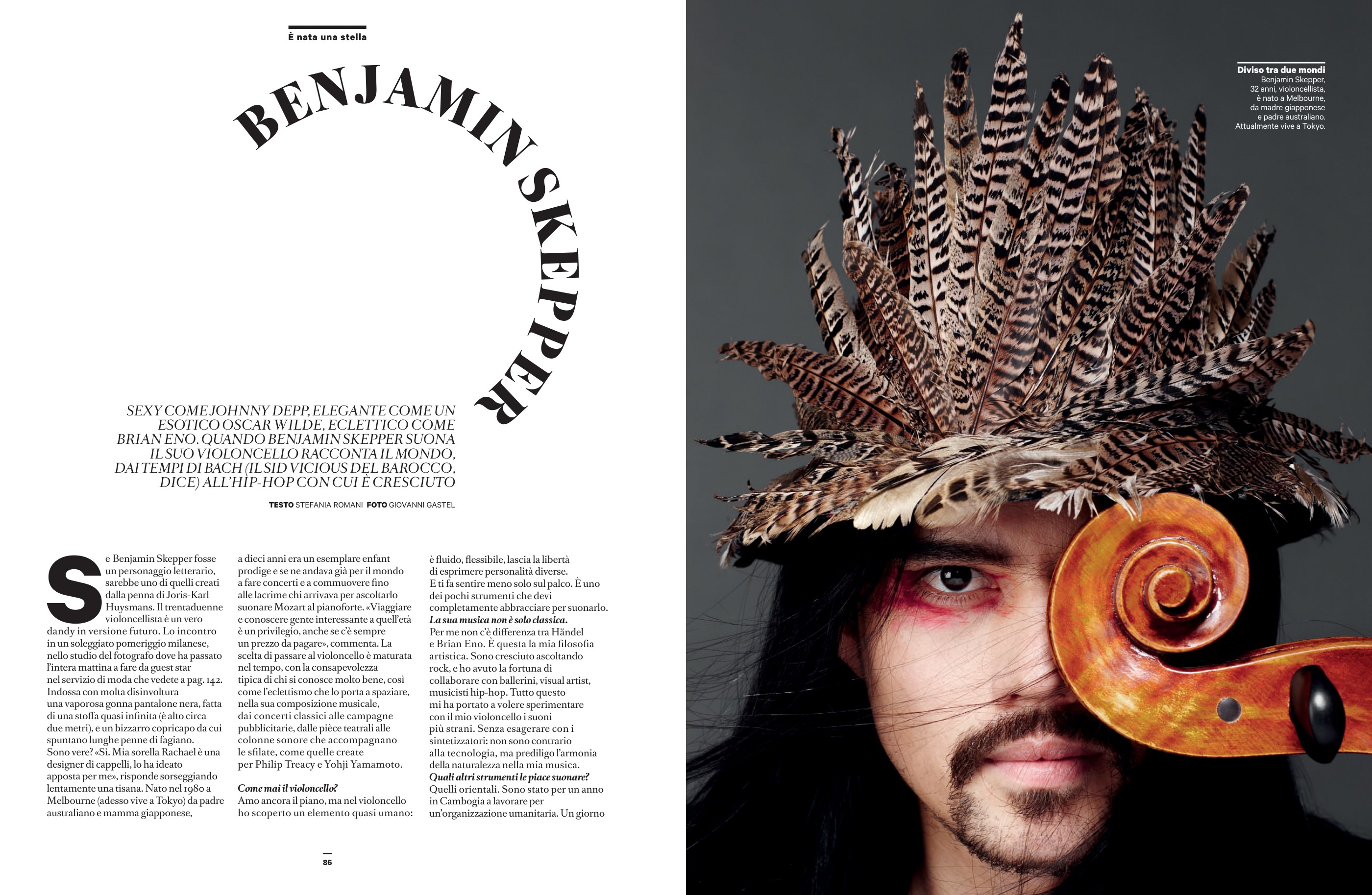
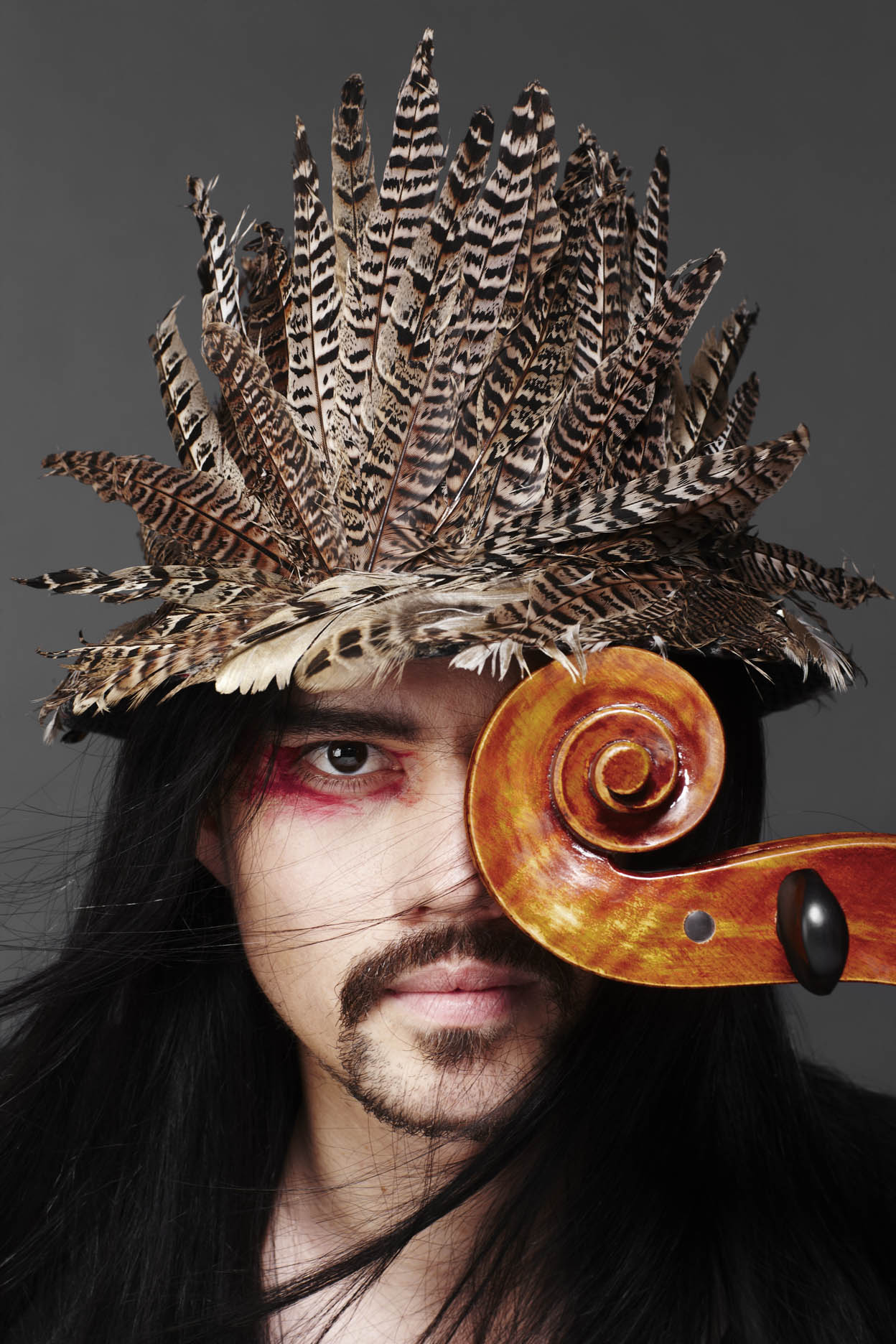
If Benjamin Skepper were a character in a novel, Stefania Romani writes, he would be one of Joris-Karl Huysmans’s: the cellist is a true dandy, updated for the future. She meets him on a sunny afternoon in Milan, in Giovanni Gastel’s studio, where he has spent the morning as guest star of the fashion shoot. He is wearing billowing black culottes cut from what seems an endless length of fabric, and a headpiece of long pheasant feathers made for him by his sister, the milliner Rachel Skepper.
…un vero dandy in versione futuro.…a true dandy, in a version for the future.Stefania Romani · AMICA
Born in Melbourne in 1980 and now based in Tokyo, he was a child prodigy at ten, she notes, already travelling the world to give concerts and moving audiences to tears with Mozart at the piano. The move to the cello came with time. So did the range of a composer whose work runs from classical concerts to advertising campaigns, and from theatre to runway soundtracks, among them those for Philip Treacy and Yohji Yamamoto.
THE CONVERSATION
Why the cello. He still loves the piano, he says, but the cello offered something else.
Nel violoncello ho scoperto un elemento quasi umano: è fluido, flessibile, lascia la libertà di esprimere personalità diverse.In the cello I found something almost human. It is fluid and flexible, and it leaves you free to express different personalities.
It makes him feel less alone on stage, he adds, and it is one of the few instruments you have to embrace completely in order to play.
Händel and Brian Eno. His music is not only classical, Romani observes.
Per me non c’è differenza tra Händel e Brian Eno. È questa la mia filosofia artistica.For me there is no difference between Händel and Brian Eno. That is my artistic philosophy.
He grew up listening to rock and has been lucky enough to work with dancers, visual artists and hip-hop musicians. All of it made him want to find the strangest sounds his cello could make, without leaning too heavily on synthesisers.
Non sono contrario alla tecnologia, ma prediligo l’armonia della naturalezza nella mia musica.I am not anti-technology, but in my music I prefer the harmony of natural sound.
Other instruments. Eastern ones. He spent a year in Cambodia working for a humanitarian organisation, woke up one morning wanting a traditional string instrument, and bought one. Back home he started a hip-hop group and then a hippie one, with sitar and didgeridoo.
Bach. His iPod holds medieval and baroque music, electronica and dub, as varied as possible. One composer sits at the top of the list.
Bach! La sua musica è spirituale, possiede il vero potere del suono. Il suo modo di sperimentare le linee melodiche indipendenti è qualcosa di rivoluzionario. Per me è il Sid Vicious del barocco.Bach! His music is spiritual. It has the true power of sound. The way he experimented with independent melodic lines was revolutionary. For me he is the Sid Vicious of the Baroque.
He would have loved to live in Bach’s time, he adds.
Cities. London, Paris and Rome, and Venice, which he calls surreal. He had been there a few months earlier for carnival, composing and performing the music for the theatre production I piaceri proibiti di Giacomo Casanova.
Tokyo and his grandmother. He left Australia for Tokyo in 2007 and says he had always known he would end up living there. His first visit, at sixteen, was a shock. His grandmother was dying and he wanted to see her again, and the country was nothing like the romantic, traditional Japan of the art book she had once given him. She shaped his spiritual life, he says, and came with him on tour from the time he was ten. He learned Japanese for her, moving to Tokyo to study it and getting by comfortably within six months.
Roots. Going to Japan was also about finding where he came from. His family is of samurai descent, and he travelled with his sister to Hiroshima to see the house where their ancestors had lived, with the katana and the antique robes still there. He calls it the most moving moment of his life.
Sono cresciuto in Australia, ma discendo da una famiglia di samurai. E ne sono orgoglioso.I grew up in Australia, but I come from a family of samurai. And I am proud of it.
Between two worlds. His grandmother came to Australia in 1953, among the first Japanese war brides, when the White Australia policy was still in force. He remembers exactly the day he was made to feel different: he went to primary school in a kimono, and the whole class turned on him. In Japan, being half Australian, he is not seen as truly Japanese either.
Sto dedicando molto tempo e risorse per conoscere veramente questo Paese. Uno dei miei più grandi desideri è farlo scoprire, poi, al resto del mondo attraverso la mia arte.I am giving a great deal of time and resources to really getting to know this country. One of my greatest wishes is to help the rest of the world discover it through my art.
Fukushima. He was in Rome, working on the album Inimitable, when the news came. He felt helpless, and guilty at not being close to his people. He also felt a deep dread: his grandmother was living in Hiroshima when the bomb fell, and no one in his family, he says, is a stranger to the nuclear nightmare.
The cost. Asked about the greatest sacrifice of his career, he says it was leaving family and friends in Australia.
Fashion. His parents were hairdressers whose clients included people from television and film, so he grew up around that world and its clothes. He would like to start a menswear line with his sister.
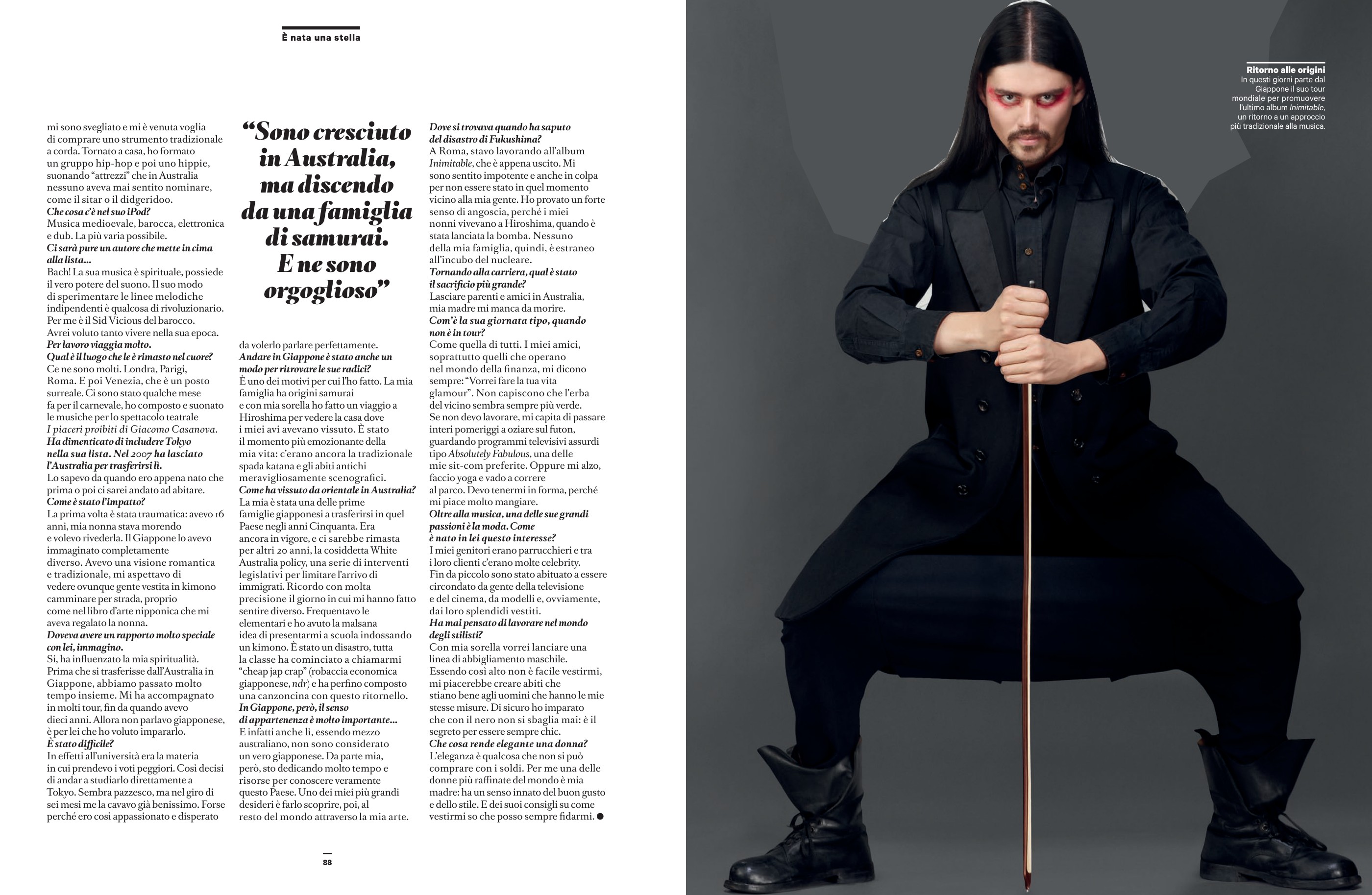
A closing note records that his world tour for Inimitable was about to set out from Japan, and describes the album as a return to a more traditional approach to music.
IN ITALIANO
Benjamin Skepper, violoncellista e compositore australiano-giapponese, è protagonista dell’intervista «È nata una stella» pubblicata da AMICA nel 2012, con testo di Stefania Romani e fotografie di Giovanni Gastel.
READ
The original interview: AMICA, 2012 (PDF, Italian)
The interview online at Oggi (Italian)
The fashion editorial: La musa e l’artista